
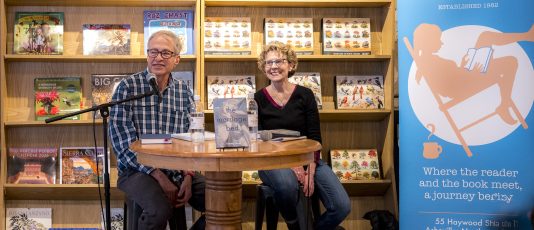
Tommy Hays in conversation with Abigail DeWitt at his launch of The Marriage Bed, Malaprop’s Bookstore/Café, March 24, 2026
As we began work on this 34th issue, I had just ventured onto Substack, a doors-wide-open literary candy store where writers and thinkers invite you to join them at work. Even more alluring is the ever-present orange banner urging you to Start Publishing Now; no rules, no thumbs-up/thumbs-down, no judgment from behind a cosmic curtain. Could anything be more democratic? More welcoming? The time was ripe for an update on the world of publishing.
To show how far we’ve come, I pulled out from our archives my Home Page essay from our first issue, which had appeared in the fall of 2008. I couldn’t recall exactly what my topic had been all those years ago, but knew it had to be some sort of proud reflection on the birth of our new-age, relatively uncommon (for those days) electronic literary publication. I gritted my teeth in preparation for what was bound to be an embarrassment. Here’s how it began:
“In January of this year, I came across a Time magazine with Lev Grossman’s article about publishing in the 21st century: that it is ‘in distress,’ that although it ‘isn’t dying …it is evolving,’ and that this evolution, at least for the published novel, will mean something that is ‘cheaper, wilder, trashier, more democratic and more deliriously fertile than ever.’ …It suddenly seemed a good idea for the Great Smokies Writing Program to have a publication of its own, and to be 21st-century about it, we’d do it electronically. As Grossman pointed out, ‘We've gone from industrialized printing to electronic replication so cheap, fast and easy, it greases the skids of literary production to the point of frictionlessness.’”
Grossman’s prediction thrilled me with its prescience, as did knowing that we had ridden, even in a very small part, its early wave. But that was eighteen years ago. By now we are all awash in digital magazines, newsletters and newspapers; e-books from publishing houses, digitized library collections, or self-published authors themselves—and blogs. The boom of the blog heralded publishing that was pretty fast and pretty easy, and, yes, democratic: available to anyone willing to put in the time of managing one. Blogging, however, also required the consistency and commitment that can conflict with a writer’s already over-booked life. Then, in 2017, Substack arose and waved its magic wand, collecting email addresses from writers and sending out their messages for them. Its subsequent advent of Notes created a community of writers and readers commenting on posts and plugging other Substacks, gathering into one neat package tasks that social media did less efficiently.
So much for the skid-greasing process. All good. But for the literary-minded potential subscriber, what about the product? What about Grossman’s assurance of the associated richness and deepness—the fertility? For an answer, consider the Substack of a member of our Great Smokies Writing Program community. Heather Newton (Under the Mercy Trees, HarperCollins; McMullen Circle, Regal House; The Puppeteer’s Daughters, Turner), who teaches frequently for the program. She began her “Cheerful Tearful, A Memoir in Toys” posts in July 2025, with this introduction: “My great, great grandmothers couldn’t have written a memoir in toys. There were few play-pretties, childhood wasn’t yet an institution, and hard plastic hadn’t been invented. But I, coming along at the tail end of the baby boom in an era of mass production, can write of toys in order to tell of other things: long goodbyes, sibling relationships, birth order, parental best efforts, choices, disappointments, things lost or regretted, the unreliability of memory, and what we really want as opposed to what we are supposed to want. Come along with me!” With that, Heather leads us onto a high-dive platform above teeming waters, and we follow her in, lured by the call to write of these things, and “other things,” ourselves.
Substack offers readers unfettered, authentic work, and allows writers to create a following however they see fit. Within its Literature category, luminaries—Margaret Atwood, George Saunders, Salmon Rushdie, Miranda July, etc.—offer a mix of meditations, irritations, writing advice, and, well, anything they like. A few have even taken on the daunting task of sharing a whole novel à la Charles Dickens, in serialized form. Among these is Junot Diaz, who is currently using his posts to restart a writing life stalled after a (self-described) failed novel. He credits his Substack subscribers with some hopeful signs: “Whatever this book’s fate, I’m grateful to all of you who have chosen to walk this path with me. Anyway, 51,000 words is the good news. The less-good news is I have no idea when we’ll see the second part. I hit a bit of a rough patch and am struggling to find my way through. It is, after all, no easy road. It's like with most relationships—there's the initial nova-burst of excitement and novelty and then, if you're lucky, comes the hard work.”
Too hard? For novel-readers, especially, or anybody more interested in story than community, the Dickens/Diaz route may not work, and for novel-writers, the posting schedule can be more pressure than motivation. Fortunately, for everybody, publishing in its printed form does endure. And if the gates of the big houses refuse to open, small presses keep theirs on the swing. Go here for Janet Moore’s conversations with the heads of three independent publishers to hear their good news. According to Kate McMullen of Hub City Press, “There are more literary writers than ever and fewer places for them to go. In today’s conglomerated publishing environment, smaller presses like Hub City have an upper hand. We’re the ones finding cool, exciting books and bringing them forward into the world.”
An especially cool and exciting new book, from Blair, another small press, is The Marriage Bed by Great Smokies Writing Program co-founder and director emeritus Tommy Hays. (See photo above, from his March book launch.) Ron Rash offers this praise: "The Marriage Bed is an exceptional novel: perfectly paced, riveting, unrelentingly honest and wise in its depiction of what William Faulkner called 'the human heart in conflict with itself.' A remarkable achievement."
